
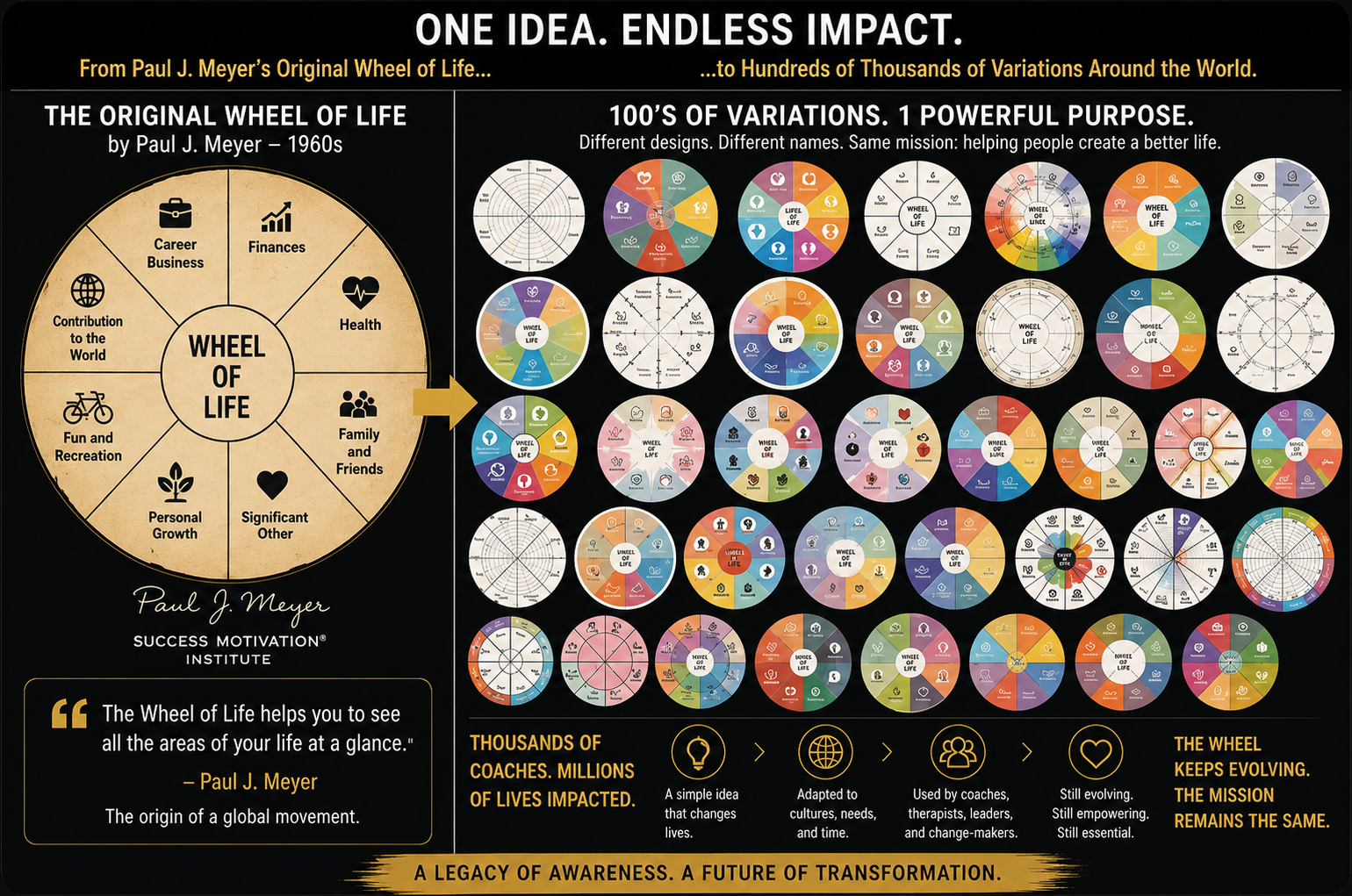

For more than 60 years, the Wheel of Life has helped millions of people pause, reflect, and recognize that life is about more than work alone. Popularized by Paul J. Meyer in the 1960s, the Wheel invited people to assess different areas of life and ask an important question:
How balanced am I?
It was a breakthrough.
At a time when careers often consumed everything else, the Wheel of Life expanded our perspective. Health mattered. Relationships mattered. Finances mattered. Personal growth mattered. The Wheel created awareness.
But awareness is not the same as transformation.
The Problem with More Wheels
Today, there are hundreds of thousands of versions of the Wheel of Life used by coaches, consultants, therapists, and organizations around the world. Different colors. Different labels. Different Parts.
Yet most still ask essentially the same question: “How satisfied am I in each area of life?”
The challenge is that modern life has changed.
We don’t struggle simply because one area of life scores too low. We struggle because life has become fragmented. We optimize our careers while sacrificing our health. We pursue financial success that conflicts with our values. We set goals in isolation without understanding how one part of life influences another.
💡 The problem isn’t a lack of wheels. The problem is that a wheel alone was never enough.
The Unicycle
For decades, we’ve been refining the wheel.
Maybe we’ve been asking the wrong question.
What good is a wheel without a seat, an axle, pedals, and a person to ride it?
A wheel by itself cannot determine direction. It cannot create momentum. It cannot carry the person whose life it represents.
ONELife isn’t another wheel.
It’s a unicycle.
And certainly not a bicycle. Because we don’t have two lives (work and life). We have one life.
The ONELife Unicycle
In the ONELife model, each part of the unicycle represents an essential component of intentional living.
The wheel represents the eight interconnected parts of life.
The seat represents Purpose, your North Star. It answers the question: Why am I here? What is the life I am trying to build?
The axle represents Values, the non-negotiable beliefs that hold everything together and keep your life aligned under pressure.
The pedals represent Principles, the practical standards that drive daily choices and behaviors. Some principles emerge from the analytical, logical strengths of the left brain. Others arise from the creative, relational, intuitive strengths of the right brain. Both are needed to move forward.
And at the center of it all is the rider: you.
The person making decisions. The person creating meaning. The person choosing how to live.
Beyond Balance
The Wheel of Life helped people survive an era that demanded balance between competing priorities.
But balance is not the final destination.
The next evolution is life strategy.
Businesses run on strategy. They establish objectives, make choices, allocate resources, and align actions toward a desired future.
Why shouldn’t our lives deserve the same intentionality?
The question is no longer: “How balanced is my life?”
The better question is: “What is my strategy for living it?”
Why ONELife Is Different
➜ Traditional wheels provide a snapshot. ONELife provides a system.
➜ Traditional wheels measure satisfaction. ONELife builds strategy.
➜ Traditional wheels focus on separate parts of life. ONELife focuses on unification.
➜ Traditional wheels raise awareness. ONELife creates rhythm through reflection, planning, adjustment, and growth.
Traditional wheels help people see life differently.
ONELife helps people live differently.
A Legacy and a Future
Paul Meyer helped millions of people recognize that life is multidimensional. That contribution should be celebrated.
But a wheel was never the vehicle.
Perhaps what we’ve needed all along was the rest of the unicycle.
A seat rooted in purpose. An axle grounded in values. Pedals powered by principles. One wheel representing the interconnected parts of life. And one person intentionally deciding where they are going and how they want to get there.
Because we don’t have two lives. We have one.
Ready to move from awareness to strategy? Explore the ONELife model to understand how the unicycle works across all eight parts of your life. Not another wheel. The whole unicycle.