


| Work-Life (Dual-System Model) | One Life (ONELife, Life Strategy OS) |
|---|---|
| Two separate spheres | One integrated life system |
| Balance | Rhythm |
| Integration | Unification |
| Harmony | Coherence |
| Trade-offs | Design choices |
| Compartmentalization | Life architecture |
| Role switching | Identity consistency |
| Time management | Energy + intention management |
| Conflict mitigation | Structural design |
| Burnout prevention | Sustainable performance |
| Boundary setting | Domain calibration |
| “Leave work at work” | Work as one spoke of the wheel |
| Stress spillover | System tension across domains |
| Achievement focus | Purpose-driven expression |
| Outcome-driven | Purpose + outcomes integrated |
| Employee as labor input/resource | Human as multi-domain system |
Investor Positioning Narrative
Category Thesis
For over 50 years, the dominant narrative has been Work-Life Balance, a dual-system model that treats work and life as competing forces. This fragmentation fuels burnout, disengagement, and reactive leadership.
💡 ONELife replaces balance, integration, and harmony with a unified Life Strategy Operating System (LSOS). Work is not separate from life. It is one domain within a coherent, architected human system.
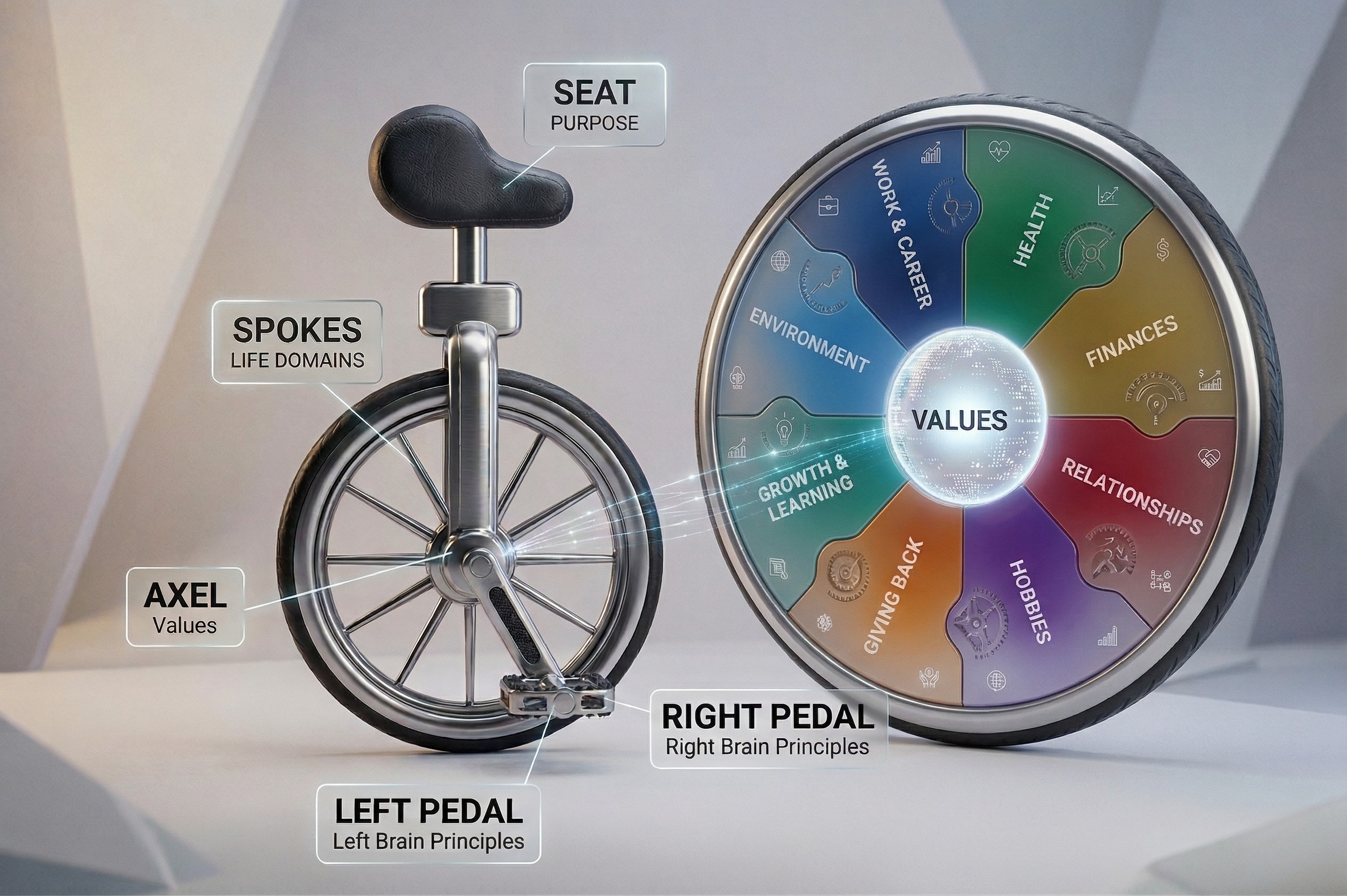
The Metaphor: Bicycle vs Unicycle
The Work-Life Balance model assumes life is a bicycle: two wheels that must be kept in equilibrium. Work on one side. Life on the other. The entire model is built on the premise that these are two separate systems that need to be managed against each other.
But life is not a bicycle. It is a unicycle.
One wheel. One system. Eight spokes, each representing a domain of life:
- Work & Career
- Finances
- Health
- Relationships
- Growth & Learning
- Environment
- Hobbies
- Giving Back
The seat is Purpose. The axle is Core Values. The pedals are Guiding Principles.
Work is one spoke, not one of two wheels. When the wheel is architected with purpose at the top and all eight domains in rhythm, performance is sustainable. When any spoke is ignored, the whole ride becomes unstable.
You cannot balance a unicycle by managing two sides. You ride it by designing the whole.
Core Differentiators of the Life Strategy Operating System
➜ Unification over Integration
➜ Rhythm over Balance
➜ Coherence over Harmony
➜ Structural Design over Trade-offs
Strategic Outcome
When leaders operate from a Life Strategy Operating System, decision quality improves, stress becomes regulated rather than suppressed, and performance becomes sustainable and scalable.
HR & Organizational Application
Traditional HR models treat employees as role-based contributors whose personal lives are external variables. The ONELife Life Strategy Operating System recognizes employees as holistic humans operating across multiple life domains.
The bicycle model created a false boundary in the workplace: the idea that an employee’s work identity and life identity are separate systems to be kept apart. The unicycle model reveals the truth: every person who shows up to work is a full human system, and the condition of every spoke (their relationships, health, purpose, finances, and growth) directly determines the quality of their performance.
By acknowledging the full human system (health, relationships, growth, purpose, and environment), organizations reduce hidden stress variables, improve engagement, and support sustainable performance.
The Life Strategy Operating System shifts organizations from burnout mitigation to structural life design, aligning human coherence with business performance.
Ready to move from fragmentation to coherence? Take the ONELife Assessment to discover your Life Strategy Intelligence score and see how your eight domains work as one unified system. Because you can’t balance what was never divided.
Because life is the work that matters most.