


Nir Eyal, Stanford lecturer and behavior design expert, has written three books forming a complete framework for human behavior and potential. Each addresses a different layer of control.
Hooked (2014): How products form habits Indistractable (2019): How to control attention Beyond Belief (2025): How beliefs shape reality
Together, they create a progression: External manipulation → Attention control → Belief transformation.
Understanding the Nir Eyal books strategy requires recognizing what they provide and what they assume.
And they’re all tactically brilliant.
But here’s what nobody’s saying: all three books assume you already know your strategic direction.
They teach you HOW to build habits, control attention, and transform beliefs. But they don’t help you determine WHICH habits to build, WHERE to direct attention, or WHAT beliefs to transform when you have competing priorities across eight different life domains.
That’s not a flaw. It’s a gap. And it’s the gap ONELife was built to fill.
Hooked: How Products Capture Your Attention
The Core Framework
Eyal’s first book, Hooked, explains how successful products form habits through a four-step model that brings users back without advertising or aggressive messaging.
The Hook Model:
- Trigger: Internal (emotion) or external (notification) cue
- Action: Simplest behavior in anticipation of reward
- Variable Reward: Unpredictable reinforcement that satisfies the craving
- Investment: User puts something in that loads the next trigger
Products that successfully hook users become part of daily routines by associating their solution with the user’s internal triggers.
Who It’s For
Product designers, entrepreneurs, marketers. Anyone who wants to understand how to build habit-forming products.
What It Addresses
External behavior design. How companies manipulate you through products.
What It Misses
Hooked teaches you why you’re hooked on apps, games, and social media. It helps you understand the mechanics of habit formation. But it doesn’t help you determine which products and activities deserve your limited attention based on strategic life priorities.
The gap:
➜ You understand why you’re hooked
➜ But you don’t have a framework for deciding which hooks to resist vs. embrace
➜ Should you be hooked on meditation apps? Fitness trackers? Work tools? How do you choose?
Indistractable: How to Control Your Attention
The Core Framework
Five years later, Eyal wrote the counterpoint to Hooked. If the first book taught companies how to capture attention, the second teaches individuals how to protect it.
Core insight: Distraction isn’t caused by technology. It’s caused by our inability to deal with discomfort. Time management is pain management.
The 4-Part Framework:
- Master Internal Triggers: Understand the discomfort driving distraction (90% of the problem)
- Make Time for Traction: Schedule your values; use timeboxing, not to-do lists
- Hack Back External Triggers: Remove notifications, redesign environment (10% of problem)
- Prevent with Pacts: Use precommitments (effort, price, identity pacts)
Key definition: Traction equals actions toward your values. Distraction equals actions away from values.
Who It’s For
Anyone struggling with attention, distraction, focus. The counterpoint to Hooked.
What It Addresses
Attention management. How to protect focus and resist distraction.
What It Misses
The critical assumption is Step 2: “Make Time for Traction: schedule your values.” But how do you determine those values across competing life domains?
The gap:
➜ Eyal says schedule “you time,” “relationship time,” and “work time”
➜ But doesn’t provide framework for: How much to each? What about other domains?
➜ When all domains feel important, which gets the limited focus?
➜ When should you reassess your schedule as life circumstances change?
💡 You can’t be distracted if you’ve decided in advance what to do with your time. But deciding what to do with your time requires knowing what matters most across all eight life domains, not just three.
Beyond Belief: How Beliefs Shape Reality
The Core Framework
In 2025, Eyal completed the trilogy with Beyond Belief, tackling the deepest layer: the beliefs that determine what we see, expect, and do.
Core insight: “Beliefs are tools, not truths.” Most limits are psychological, not physical. You can identify and replace limiting beliefs with empowering ones.
The Three Powers of Belief:
- Attention: Beliefs determine what you notice
- Anticipation: Beliefs shape expectations (placebo/nocebo effects)
- Agency: Beliefs influence whether you take action
Key distinction: This isn’t positive thinking (pretend everything is great). It’s strategic belief adoption: Choose beliefs that serve goals, knowing they’re tools.
Evidence includes surgeries without anesthesia, placebos healing as well as medicine, resilience multiplied 240x, athletes breaking “impossible” limits.
Who It’s For
Anyone suspecting limiting beliefs hold them back. Want science-backed belief transformation without woo-woo.
What It Addresses
Belief transformation. How to replace limiting beliefs with empowering ones.
What It Misses
Beyond Belief helps you transform beliefs, but assumes you know which beliefs to work on when you have limiting beliefs across multiple life domains.
The gap:
➜ You might have limiting beliefs about career, health, relationships, creativity
➜ Belief transformation takes time and energy
➜ Which domain’s beliefs should you tackle first?
➜ How do you prioritize belief work when everything feels limiting?
The Universal Pattern: Tactics Without Strategy
All three books are tactically brilliant. All three assume you already know your strategic direction.
Hooked says: “Build habits.” But which habits? In which domains? Serving which strategic priorities?
Indistractable says: “Schedule your values.” But how do you determine and prioritize values across domains?
Beyond Belief says: “Transform limiting beliefs.” But which beliefs to work on when you have them everywhere?
This isn’t a criticism of Eyal’s work. His books are masterful. But they operate at the tactical level, not the strategic level.
And without strategy, even the best tactics lead to fragmentation.
You end up with great habits, attention control, and empowering beliefs, potentially in the wrong domains. Efficient execution without effective direction. Tactics without strategy.
What ONELife Adds: The Strategic Layer
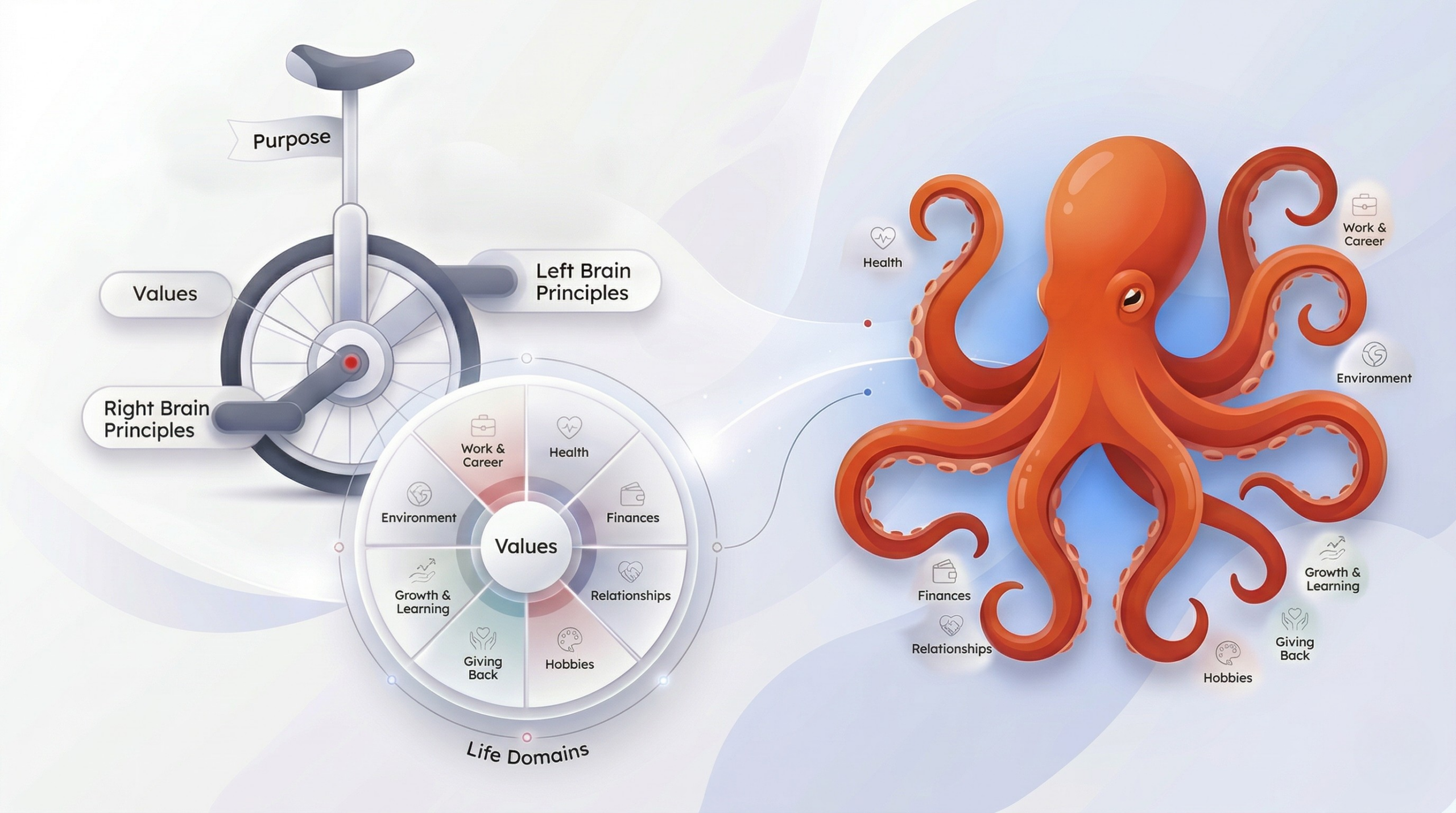
ONELife is the strategic operating system that sits above the trilogy. It determines which domains to apply Eyal’s frameworks to, when to shift focus, and how to balance competing priorities.
The Nir Eyal books strategy stack needs a foundation: strategic direction across life domains.
Here’s how the integration works:
Step 1: Strategic (ONELife, Quarterly)
Assess eight life domains, identify top 2-3 priorities, allocate time and energy.
The eight domains:
- Work and Career
- Finances
- Relationships
- Health and Well-Being
- Hobbies and Personal Passions
- Giving Back
- Growth and Learning
- Environment
ONELife helps you answer: Which 2-3 domains are priorities NOW? What deserves focus this quarter?
Step 2: Belief (Beyond Belief, Monthly)
Within priority domains, identify and transform limiting beliefs.
Example: If Leadership is priority 1, focus belief work on “I can lead effectively,” not scattered belief work everywhere.
Step 3: Attention (Indistractable, Weekly)
Schedule traction time for priority domains, protect from distraction.
Example: ONELife says Leadership + Family. Schedule traction time for those, not random productivity.
Step 4: Habits (Hooked, Daily)
Build hooks and habits that serve strategic priorities in focus domains.
Example: If Health is priority 1, design hooks for workout apps, not social media.
The Complete Behavior Stack
Without the strategic layer (just Eyal’s books):
➜ Great beliefs, attention, and habits… potentially in wrong domains
➜ Efficient execution without effective direction
➜ Tactics without strategy
With the strategic layer (ONELife + Eyal):
➜ Strategic priorities clear across life domains
➜ Beliefs, attention, and habits aligned with strategy
➜ Direction + Execution = Intentional progress
How This Works Practically
Let’s say you read all three Eyal books and implement everything perfectly.
You’ve transformed your beliefs. You’ve scheduled traction time. You’ve built powerful habits.
But you’ve done it across all eight domains simultaneously. You’re trying to:
➜ Build new career habits
➜ Transform health beliefs
➜ Schedule relationship time
➜ Protect financial focus
➜ Develop creative skills
➜ Contribute to causes
➜ Learn new things
➜ Improve your environment
All at once. With the same 168 hours per week.
The result? Fragmentation. You make scattered progress in eight directions while nothing truly moves forward.
Now add ONELife to the stack.
ONELife helps you say: “This quarter, Leadership and Health are priority 1 and 2. Everything else is maintenance mode.”
Now:
➜ Beliefs (Beyond Belief): Transform limiting beliefs about leadership capability
➜ Attention (Indistractable): Schedule traction time for leadership development and health
➜ Habits (Hooked): Build hooks for morning workouts and weekly team check-ins
Same tools. Strategic direction. Unified progress.
Why This Integration Matters
Eyal’s trilogy is among the best tactical frameworks available for behavior change. Millions of people have read these books. They’ve learned how habits form, how to control attention, how to transform beliefs.
But most still struggle.
Not because the tactics don’t work. But because they’re applying tactics without strategic clarity.
They’re building habits in domains that don’t serve their purpose. They’re protecting attention for work that doesn’t align with their values. They’re transforming beliefs in areas that aren’t priority right now.
The tactics work. The direction is missing.
ONELife provides the direction.
Bringing the Frameworks Together
Nir Eyal has authored a remarkable trilogy on behavior design. His work is evidence-based, practical, and deeply valuable for anyone trying to build better habits, control attention, or transform limiting beliefs. You can explore his frameworks further at NirAndFar.com and through his books available on major platforms.
Research supporting these concepts spans behavioral psychology, neuroscience, and habit formation studies. The American Psychological Association provides extensive resources on habit formation and behavior change. Studies on attention management and productivity reinforce the importance of strategic focus.
ONELife extends these tactical frameworks by adding the strategic architecture that determines where to apply them, when to shift focus, and how to ensure all efforts move in one unified direction.
What Comes Next
Eyal teaches HOW.
ONELife teaches WHAT and WHEN.
Together: A complete framework for intentional living.
Not just better habits, attention, and beliefs. Better habits, attention, and beliefs in the right domains, at the right time, toward strategic goals.
Because in the end, tactics without strategy is just noise.
And strategy without tactics is just planning.
But when you combine both, you get something powerful: a life that actually works.
The Nir Eyal books strategy is powerful when combined with ONELife’s strategic operating system.