
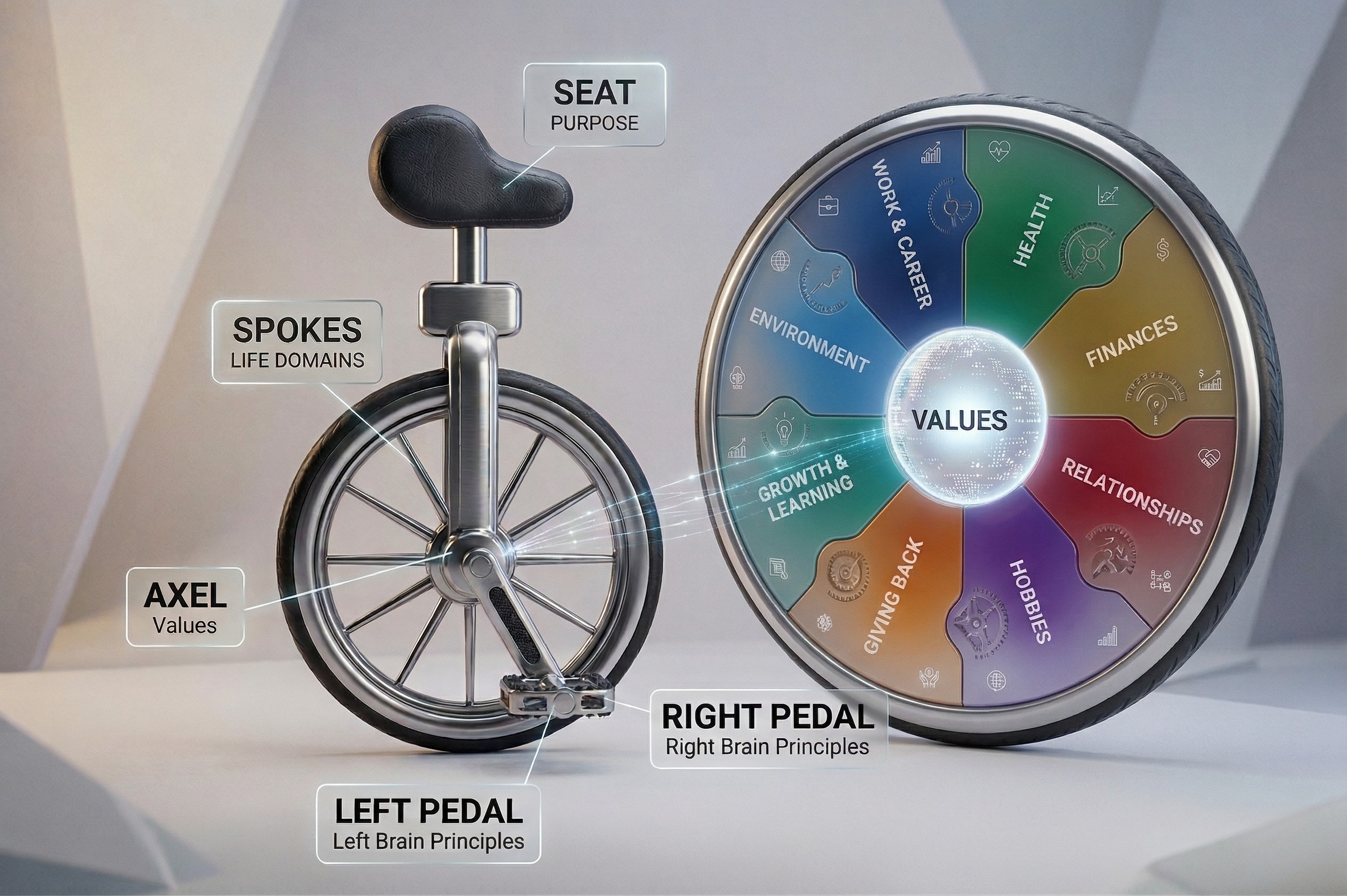

The ONELife Unicycle has two levels. The foundation and your identity (Seat: Purpose, Axle: Core Values, Pedals: Guiding Principles) is where your whole life gets its direction and coherence. The eight domains are where that direction becomes daily reality. Most reading lists address the domains. This one starts at the foundation.
Three books per section. Curated for insight, not popularity. Every entry connects directly to how you use ONELife.
Part One: The Unicycle Foundation
Seat · Axle · Pedals
The Seat: Purpose
Purpose is the seat of the unicycle: your long-term direction, legacy orientation, and 10 to 20 year aims. If the seat is unstable, everything wobbles. These three books help you find and articulate yours.
1. Man’s Search for Meaning by Viktor Frankl
Written after surviving four Nazi concentration camps, Frankl’s account of how meaning sustains human beings through suffering is one of the most important books ever written. His central thesis: meaning is not found, it is chosen.
ONELife lens: Purpose in ONELife is not a tagline. It is the answer to “what am I building and why does it matter?” Frankl’s framework (meaning through work, love, and suffering) is the deepest starting point for honest Purpose work.
2. Start With Why by Simon Sinek
Sinek’s Golden Circle (Why, How, What) showed a generation of leaders that the most compelling organizations and individuals lead from purpose, not product. The argument is simple and the evidence is hard to dismiss.
ONELife lens: Start With Why is the most accessible entry into Purpose as strategy. It reframes Purpose from a philosophical exercise into a practical competitive advantage, exactly the framing ONELife uses.
3. The Second Mountain: The Quest for a Moral Life by David Brooks
Brooks argues that the first mountain (achievement, success, status) leaves most people empty. The second mountain is about commitment, vocation, and living for something beyond yourself. One of the most honest books about mid-life purpose.
ONELife lens: The Second Mountain is for ONELife users who have succeeded by conventional measures and still feel the seat wobbling. Brooks names the problem precisely: you built the life you were told to want, not the one you were made for.
The Axle: Core Values
Values are the axle. They transfer force from intention to action. When values are unclear, indecision expands. That is Parkinson’s Law at the identity level. These three books help you clarify what you actually value, not what you think you should.
1. Dare to Lead by Brené Brown
Brown’s research on values, courage, and vulnerability in leadership is some of the most rigorous in its field. The values clarification exercise alone (narrowing to two core values from a list of dozens) is worth the entire book.
ONELife lens: ONELife asks you to name your core values before setting a single objective. Brown gives you the most honest process for doing that work, and the research showing why vague values produce vague lives.
2. The Courage to Be Disliked by Ichiro Kishimi & Fumitake Koga
A Socratic dialogue structured around Adlerian psychology. The core argument: most unhappiness comes from living by other people’s values rather than your own. Discomfort is the price of authenticity.
ONELife lens: Values clarification requires separating what you were taught to value from what you actually value. This book is the most challenging read on the axle. It pushes you to own your values unconditionally, which is exactly what ONELife requires.
3. Essentialism: The Disciplined Pursuit of Less by Greg McKeown
Essentialism is a values book disguised as a productivity book. McKeown’s core argument (that doing less, better, is the path to contribution) only makes sense if you are clear on what actually matters to you.
ONELife lens: Values without prioritization are just a list. Essentialism gives you the decision-making framework that your core values need to become operational, the bridge between the Axle and the POST framework.
The Pedals: Guiding Principles
Principles are the pedals. They create movement. They determine what gets prioritized, what gets eliminated, and how decisions get made. Without clear principles, tasks multiply and time stretches. These three books help you build rules you can actually live by.
1. Principles: Life and Work by Ray Dalio
Dalio spent decades codifying the rules he uses to make decisions in markets, in organizations, and in life. The result is the most systematic treatment of personal and professional principles in the business literature.
ONELife lens: This is the definitive book on the Pedals. Dalio’s core insight (that principles are algorithms for decision-making under uncertainty) maps directly onto how ONELife uses guiding principles to generate consistent tactics across all eight domains.
2. The Daily Stoic by Ryan Holiday
A year of daily meditations drawn from Marcus Aurelius, Epictetus, and Seneca. Stoicism is a practical framework for living according to your values regardless of circumstances: not pessimism, but principled resilience.
ONELife lens: Guiding principles must hold under pressure. The Stoics built their principles specifically for adversity. ONELife users who want principles that survive real life (not just good days) will find the Stoic toolkit essential.
3. Atomic Habits by James Clear
Clear’s framework for building habits through systems rather than goals is one of the most practically useful books of the last decade. The four laws of behavior change give you a repeatable method for turning principles into daily action.
ONELife lens: Principles without execution infrastructure remain aspirational. Atomic Habits is the tactics engine for your Pedals. It answers how to make guiding principles show up in behavior automatically, which is exactly what the weekly rhythm in ONELife is designed to support.
Part Two: The Eight Life Domains
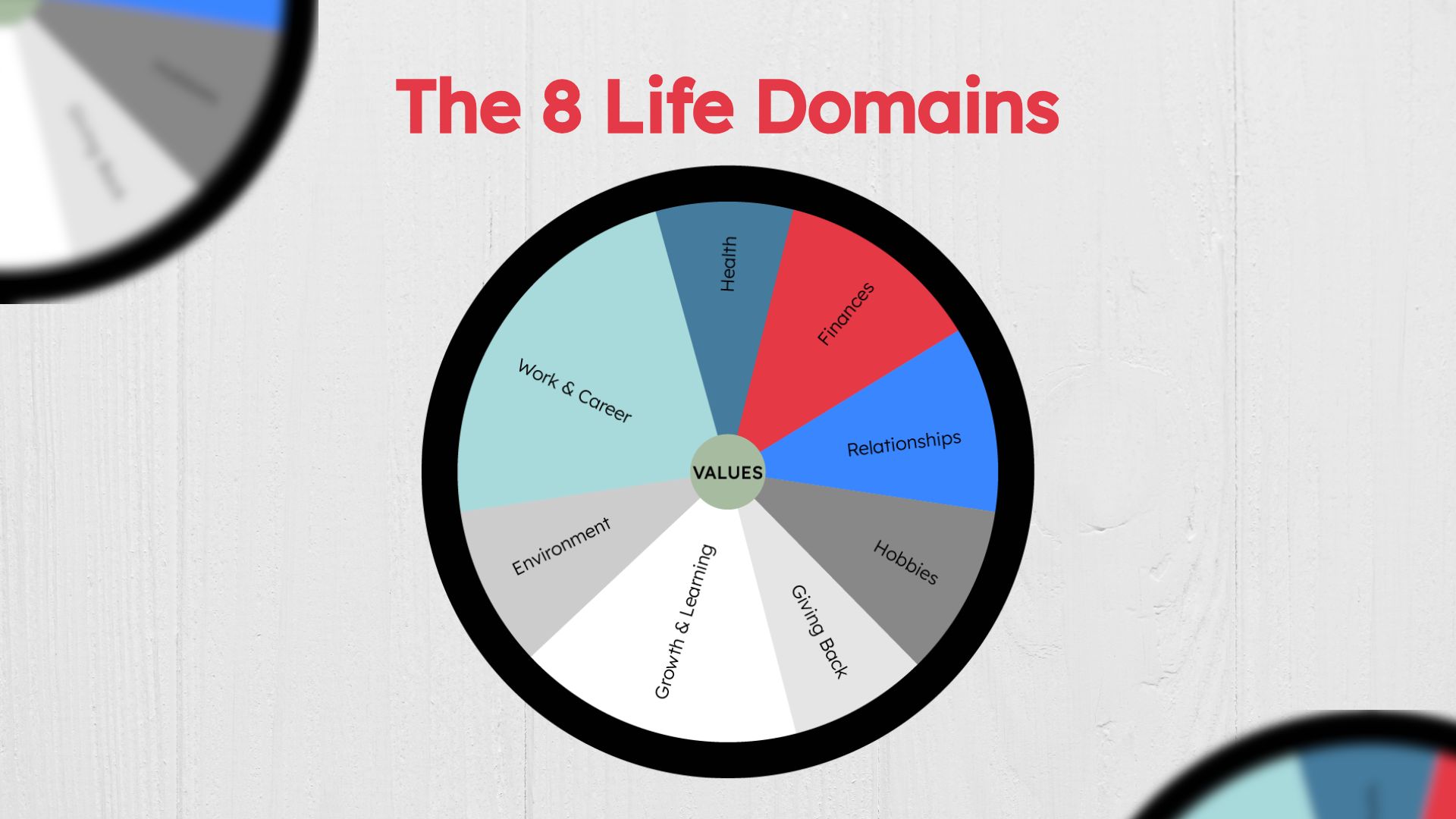
Health · Finances · Relationships · Work & Career · Growth & Learning · Environment · Giving Back · Hobbies
Domain 1: Health
Health is not a domain you manage. It is the physical infrastructure everything else runs on. These three books treat it as such.
1. Outlive: The Science and Art of Longevity by Dr. Peter Attia
A rigorous, evidence-based approach to extending healthspan, not just lifespan. Attia reframes health as proactive strategy, covering exercise, nutrition, sleep, and emotional health as interconnected systems.
ONELife lens: Attia’s framework maps directly onto POST for the Health domain: your health profile, domain objectives, strategy, and weekly tactics. One of the few health books that thinks like a systems designer.
2. Why We Sleep by Matthew Walker
The most compelling case ever made for sleep as the single most important lever in human performance. Walker’s research connects sleep deprivation to cognitive decline, emotional dysregulation, and chronic disease.
ONELife lens: Every other domain in your life is degraded when sleep is compromised. This book makes the structural argument for why sleep belongs in your weekly rhythm as a non-negotiable, not a variable.
3. The Body Keeps the Score by Dr. Bessel van der Kolk
A landmark work on how trauma is stored in the body and how physical practices (movement, breath, somatic work) are essential for healing. Goes far beyond conventional mental health frameworks.
ONELife lens: Health and identity are inseparable. Understanding the body-mind connection is foundational to honest profiling in the Health domain, and to understanding why willpower alone rarely creates lasting change.
Domain 2: Finances
Financial decisions are almost never purely rational. These three books address the psychology, the strategy, and the philosophy of money in that order.
1. The Psychology of Money by Morgan Housel
Why smart people make poor financial decisions, and why behavior matters more than knowledge in building wealth. Housel uses short stories and research to reframe money as a tool for freedom, not status.
ONELife lens: Financial decisions are driven by values and beliefs more than spreadsheets. This book helps you surface what is actually driving your financial behavior, essential groundwork before building a financial strategy inside ONELife.
2. Die With Zero by Bill Perkins
A provocative argument that over-saving is its own form of failure. Perkins challenges the assumption that maximizing wealth is the goal, and instead asks: what is your money actually for, across the arc of your life?
ONELife lens: ONELife asks you to connect your financial domain to your purpose and values. Die With Zero is the clearest articulation of why that connection matters: money in service of life, not the other way around.
3. I Will Teach You to Be Rich by Ramit Sethi
Practical, no-nonsense personal finance for people who are tired of being judged for spending on what they love. Sethi’s system automates the fundamentals so you can focus on what matters.
ONELife lens: Tactics without strategy become busy work. Sethi handles the financial tactics. ONELife provides the strategic layer, connecting your financial objectives to the purpose and values that make them worth pursuing.
Domain 3: Relationships
Relationship patterns are structural, not personal failures. These three books give you the diagnostic language to understand what is actually happening beneath the surface of your closest connections.
1. Attached by Amir Levine & Rachel Heller
Attachment theory made accessible and actionable. Levine and Heller explain how three attachment styles (secure, anxious, avoidant) shape every relationship, and how to move toward more secure connection.
ONELife lens: Understanding your attachment style is one of the most important profile inputs in the Relationships domain. It shapes your strategy before you write a single tactic.
2. The 5 Love Languages by Gary Chapman
A simple but powerful framework for understanding how people give and receive love differently. What feels like love to one person may feel neutral or even negative to another. The mismatch is often the problem.
ONELife lens: Relationships fail not always from lack of effort but from misaligned effort. Chapman’s framework is a precision tool for the strategy layer of your Relationships domain: direct your energy where it actually lands.
3. Hold Me Tight by Dr. Sue Johnson
Based on Emotionally Focused Therapy (EFT), Johnson explains the core moves in relationship breakdown and repair. Deeply grounded in attachment science, it is practical for both couples and individuals.
ONELife lens: Relationships are the domain most people track least intentionally. Johnson gives you the diagnostic language to understand what is actually happening beneath the surface of your closest relationships.
Domain 4: Work & Career
Work is one domain among eight, not one of two. These three books treat it with exactly that proportion: important, strategic, and kept in its place.
1. So Good They Can’t Ignore You by Cal Newport
A direct challenge to the “follow your passion” advice. Newport argues that rare and valuable skills (built through deliberate practice) are what create career capital, and career capital creates meaningful work.
ONELife lens: Passion follows mastery, not the other way around. Your Work strategy in ONELife should be built around skill development, not job-seeking. Newport gives you the framework for that.
2. Range: Why Generalists Triumph in a Specialized World by David Epstein
Epstein challenges the 10,000-hour rule and the early specialization model, showing that breadth of experience often produces more durable expertise and adaptability than narrow early focus.
ONELife lens: Many people in the Work domain feel the tension between depth and breadth. Range gives you the intellectual permission and the evidence to build a career strategy that draws on your full experience, not just your job title.
3. Deep Work by Cal Newport
The ability to focus without distraction is becoming rare and increasingly valuable. Newport’s framework for protecting cognitive depth is both a competitive strategy and a quality-of-life argument.
ONELife lens: Deep Work operates at the T level of POST for the Work domain: what specific practices will protect your cognitive capacity and produce your best professional output?
Domain 5: Growth & Learning
Growth & Learning is the domain most people treat as passive, something that happens to them. These three books turn it into deliberate strategy.
1. Mindset: The New Psychology of Success by Carol Dweck
Dweck’s landmark research on fixed vs. growth mindset is one of the most replicated findings in psychology. How you think about your own intelligence and ability shapes what you attempt and what you achieve.
ONELife lens: Mindset is the Profile layer of the Growth domain. Without understanding your own learning orientation, every objective you set is filtered through an invisible assumption about whether you are capable of it.
2. Ultralearning by Scott Young
A framework for aggressive, self-directed learning, built from case studies of people who mastered difficult skills rapidly outside of traditional institutions. Young extracts the principles into a repeatable system.
ONELife lens: Ultralearning turns Growth & Learning from something that happens to you into something you design. That is exactly how POST treats every domain.
3. The Art of Learning by Josh Waitzkin
Chess prodigy turned martial arts world champion, Waitzkin explores how principles of mastery transfer across domains. A rare book that is both deeply personal and theoretically rigorous.
💡 ONELife lens: The most powerful insight for ONELife users: learning principles that apply across domains compound faster than domain-specific knowledge. Designing your Growth strategy around transferable principles is whole-life thinking.
Domain 6: Environment
Environment shapes behavior more than motivation does. Most people design their environment by default. They take what is available. These three books invite you to design it intentionally.
1. The Life-Changing Magic of Tidying Up by Marie Kondō
More than a cleaning book. Kondō’s KonMari method is a philosophy of intentional living. The central question (“Does this spark joy?”) is a values filter applied to every physical object in your life.
ONELife lens: The Environment domain in ONELife is not just about aesthetics. It’s about designing the physical conditions that support every other domain. Kondō gives you the starting framework.
2. The Organized Mind by Daniel Levitin
A neuroscientist explains how the physical and digital environment overloads the brain, and what can be done about it. Covers information management, decision fatigue, and the architecture of productive spaces.
ONELife lens: Cognitive load is a real performance variable. Levitin’s research connects your Environment domain directly to Health and Work. A cluttered environment is not a preference issue, it is a systems issue.
3. A Pattern Language by Christopher Alexander
A classic of architecture and design that argues human beings flourish in environments built around specific patterns: scale, light, threshold, community. Counterintuitively, one of the best books on what home actually means.
ONELife lens: Alexander’s framework is a rare invitation to design your environment intentionally around human flourishing. That is ONELife thinking applied to space.
Domain 7: Giving Back
Giving Back is where many people feel the gap between how they want to live and how they actually live. These three books close that gap from three different angles.
1. Give and Take by Adam Grant
Grant’s research identifies three types of reciprocity styles (givers, takers, and matchers) and shows why givers, despite short-term costs, tend to rise highest over time. A rigorous, surprising book.
ONELife lens: Giving Back reframed: contribution is not sacrifice, it is the long-game strategy. Fully aligned with the ONELife thesis that your domains compound when they align with your purpose.
2. Man’s Search for Meaning by Viktor Frankl
Also listed under Purpose, and it earns its place here too. Frankl’s account of meaning through suffering is the most honest answer to the question: what are you for, beyond yourself?
ONELife lens: Giving Back is ultimately a Purpose question. If your Purpose section in ONELife feels empty, and your Giving Back domain feels performative, Frankl is the book that changes that.
3. The Go-Giver by Bob Burg & John David Mann
A business parable about five laws of stratospheric success, all centered on the paradox that shifting focus from getting to giving produces the greatest results. Deceptively simple and surprisingly moving.
ONELife lens: The most accessible entry point into contribution as strategy. Works well as a gateway into the Giving Back domain for people who have spent their career in purely transactional mode.
Domain 8: Hobbies
The most under-resourced domain in most ONELife users’ lives. These three books make the non-negotiable case for treating Hobbies & Fun as a strategic domain, not a guilt-ridden afterthought.
1. Flow: The Psychology of Optimal Experience by Mihály Csíkszentmihályi
The foundational work on flow states: the conditions under which human beings experience deep engagement, timelessness, and intrinsic reward. One of the most cited works in positive psychology.
ONELife lens: The Hobbies domain is where flow is most accessible. Csíkszentmihályi’s framework helps you design the conditions for peak experience rather than waiting for it to happen.
2. Play: How It Shapes the Brain, Opens the Imagination, and Invigorates the Soul by Dr. Stuart Brown
A clinical researcher makes the case that play is not a reward for productivity. It is a biological necessity. Brown shows how adults who abandon play become rigid, less creative, and more prone to burnout.
ONELife lens: Brown’s research makes the non-negotiable case for treating Hobbies & Fun as a strategic domain. High-achievers who cut play first pay for it everywhere else in the unicycle.
3. Big Magic: Creative Living Beyond Fear by Elizabeth Gilbert
A generous, honest book about living a creative life, not as an artist necessarily, but as a person who pursues curiosity over fear. Gilbert’s voice is warm and the ideas are genuinely liberating.
ONELife lens: Big Magic belongs here because creativity is a practice, not a talent. It also sits at the intersection of Hobbies and Growth & Learning, which is exactly where the most energizing life activities tend to live.
How to Use This List
➜ 33 books across 11 sections
➜ You don’t read them all at once
➜ Start with the section that feels most stuck or most neglected
Read one book. Then open the ONELife app and see what shifts in how you answer the questions for that section.
The Foundation sections (Purpose, Values, Principles) are where most people underinvest. If your domains feel unstable, the seat is probably wobbling. Start there.
One life. One system. Build it well. That’s ONELife.