

For over a decade, two ideas have dominated the people agenda: Psychological safety. And purpose at work.
Both are real. Both are important. And both are being implemented backwards.
Look at the numbers.
89% of employees say psychological safety is essential. Only 50% say their managers actually create it. (Deloitte)
Only 30% of US workers feel a strong sense of purpose at work. Down from 38% before the pandemic.
US employee engagement just hit its lowest point in a decade: 31%. (Gallup 2024)
And here’s the one that should stop every HR leader cold:
37% of people who quit in 2024 left because of poor engagement or toxic culture. 31% left due to burnout. Only 16% left for better pay.
They’re not leaving for money. They’re leaving because something is missing.
The Uncomfortable Truth About Psychological Safety
It assumes your people already know why they’re there.
They don’t.
You can feel psychologically safe and still be living a fragmented life. You can speak up in meetings and still feel completely lost in your career. You can admit mistakes and still be silently drowning in poor health, burnout, debt, or disconnection.
💡 Safety without personal purpose creates comfort. Comfort without coherence creates drift. Drift is what you’re measuring when engagement hits 31%.
The Uncomfortable Truth About “Purpose at Work”
Most organizations are asking employees to borrow the company’s purpose and call it their own.
“Our mission is to transform logistics.”
That’s not your purpose. That’s theirs.
Real purpose is personal. It pre-exists the job. And no purpose workshop, values exercise, or culture initiative creates it.
McKinsey said it plainly: “Employees expect their jobs to bring significant purpose to their lives. Employers need to help meet this need, or be prepared to lose talent to companies that will.”
But here’s what McKinsey didn’t say: You can’t give someone purpose. You can only create conditions where people who already have it can bring it to work.
That’s the gap.
The Sequence That Actually Works
1. Personal purpose: Built before they walk through the door
2. Psychological safety: Allows that purpose to surface at work
3. Alignment: Between who they are and what they do
4. Genuine engagement: The kind no survey can manufacture
Most organizations skip step one entirely. Then spend billions wondering why steps two, three, and four don’t stick.
The Future of Leadership
The future of leadership isn’t just: “Can my team speak up?”
It’s: “Are my people showing up with a life that actually works, before they walk through the door?”
That’s a different level of responsibility. And a different level of courage.
We don’t need to abandon psychological safety. We need to go deeper than it.
The question isn’t: Is your team safe?
The question is: Do your people have a design for their life, or are they just borrowing yours?
What If There Was a Different Starting Point?
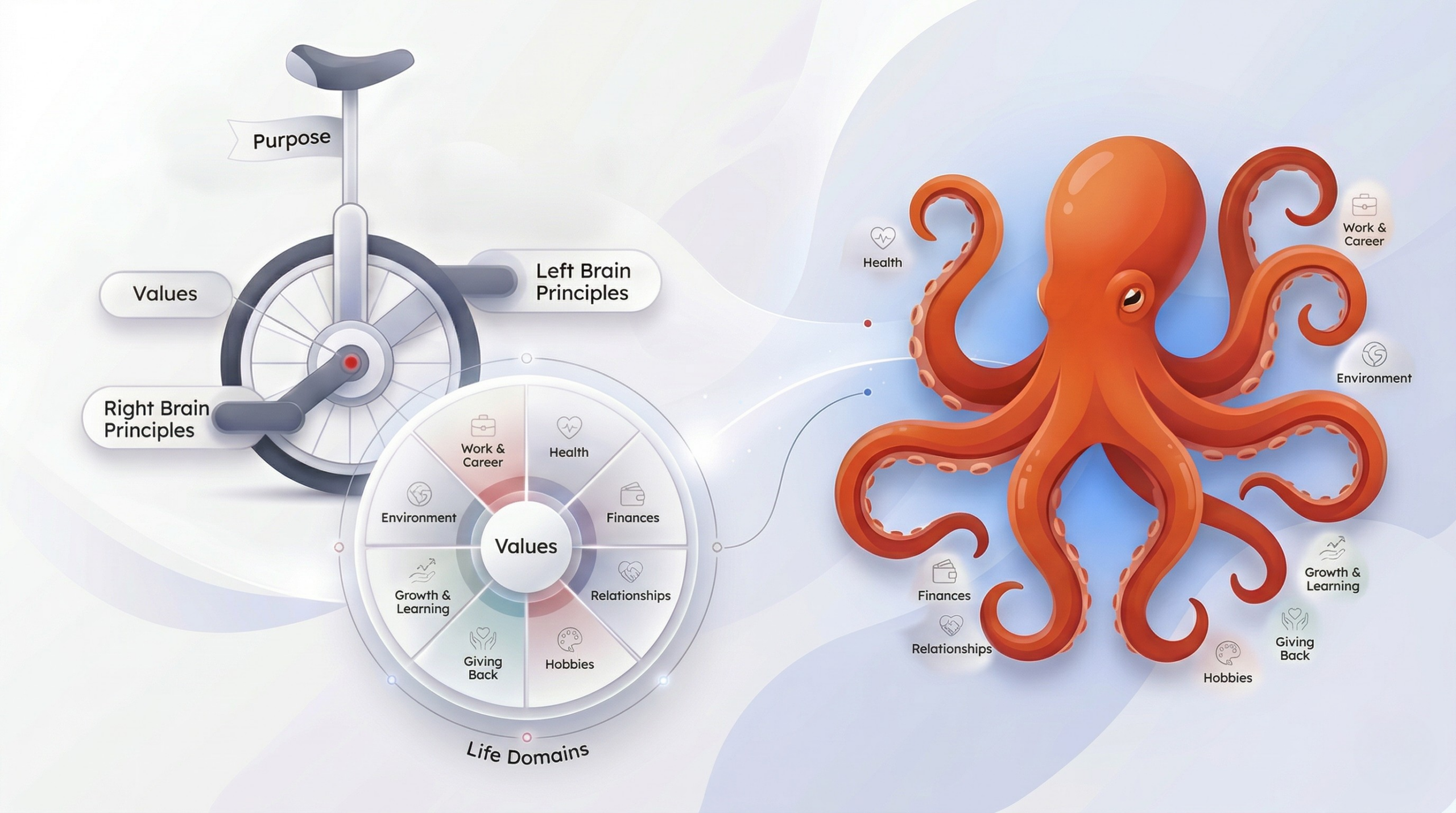
What if every person in your organization had a Life Strategy Intelligence Score, a personal score across the 8 domains of their life: work/career, finances, health, relationships, growth/learning, environment, hobbies, and giving back?
Not a HR metric. Not a performance review. Not shared without consent. Confidential to them. Built for them. A mirror, not a report card.
For the Individual
Clarity on who they are, where they stand, and what needs their attention, across their whole life, not just their job title.
For the Organization
The value flows four ways:
1. Aggregated insight: Anonymized, cohort-level data shows leadership where their people are genuinely struggling. Not guesswork. Not another engagement survey. Real signal.
2. Performance as proof: You don’t need to see the score. You see the outcome. People with personal clarity perform differently: less burnout, sharper decisions, stronger teams.
3. Consent-based coaching: Employees choose what to share with their manager or coach. The individual stays in control. Trust stays intact.
4. A talent brand that means something: Organizations that invest in their people as whole humans, not just as roles, attract and keep the people who make the real difference.
This is what ONELife is built on. The world’s first Life Strategy OS, giving individuals a design for their life and giving organizations the conditions where engaged humans actually thrive.
Not a framework. A new starting point with an app.
A Final Word. And a Warning.
Work-life balance is 50 years old. It was invented for a world that no longer exists: factories, punch cards, and a clean line between the person who clocked in and the person who went home.
That line is long gone. It has been gone for decades.
Work-life integration? Work-life harmony? Different words. Same broken premise. They all assume there are two lives to manage.
There aren’t.
There is one life. Yours. And every framework, every HR initiative, every wellbeing program, built on the idea of balance, is solving a problem that was never real.
Corporations and HR leaders have a choice. Keep patching a 50-year-old model with new language. Or finally recognize what every burned-out, disengaged, quietly quitting employee already knows:
We don’t have a work life and a personal life. We have one life.
It’s time to build for that.
A Warning to Coaches and Consultants
If your practice is built on work-life balance, integration, or harmony, you’ve built something real. You’ve helped real people. And you’ve been well rewarded for it.
This isn’t an accusation. It’s capitalism working exactly as designed.
But the model you’re selling is 50 years old. And your clients, the ones paying you tens of thousands of dollars, deserve to know that the framework underneath your methodology was built for a world that no longer exists.
The most successful coaches and consultants in the next decade won’t be the ones who perfected the old model. They’ll be the ones who dared to question it first.
Your clients don’t have a work life and a personal life to balance. They have one life to design.
The question is: are you equipped to help them do that?
Ready to help your organization move from psychological safety to life strategy? Contact us to learn how the Life Strategy Intelligence Score can give your people the clarity they need and your organization the insights that matter.
Because life is the work that matters most.