

Two AWS executives just published a Harvard Business Review bestseller arguing that organizations need to stop behaving like machines.
The book is called The Octopus Organization.
Their argument: most companies are Tin Men. Rigid. Hierarchical. Top-down. Treating the business like a machine to be engineered and controlled.
The octopus is the opposite. Distributed intelligence. Each arm senses, decides and acts independently, while remaining part of a coherent whole.
It’s a compelling framework.
And the moment I read it, I thought: this is exactly what’s happening at the individual level too.
Most People Run Their Lives Like Tin Man Individuals
Work over here. Health somewhere else. Relationships squeezed in between. Finances managed reactively. Each domain optimized in isolation, with no coherent whole pulling it together.
We call this work-life balance. Or integration. Or harmony.
Different words. Same broken architecture.
A life that’s complicated. Not coherent.
And when something goes wrong (burnout, misalignment, disconnection, quiet quitting, divorce, the nagging sense that even success doesn’t feel like enough), the Tin Man response is to fix the broken part: add more habits. Optimize the sleep. Hire a coach. Take a holiday.
💡 You’re engineering a machine. But you’re not a machine.
The Octopus Works Because It Has Something Most People Don’t
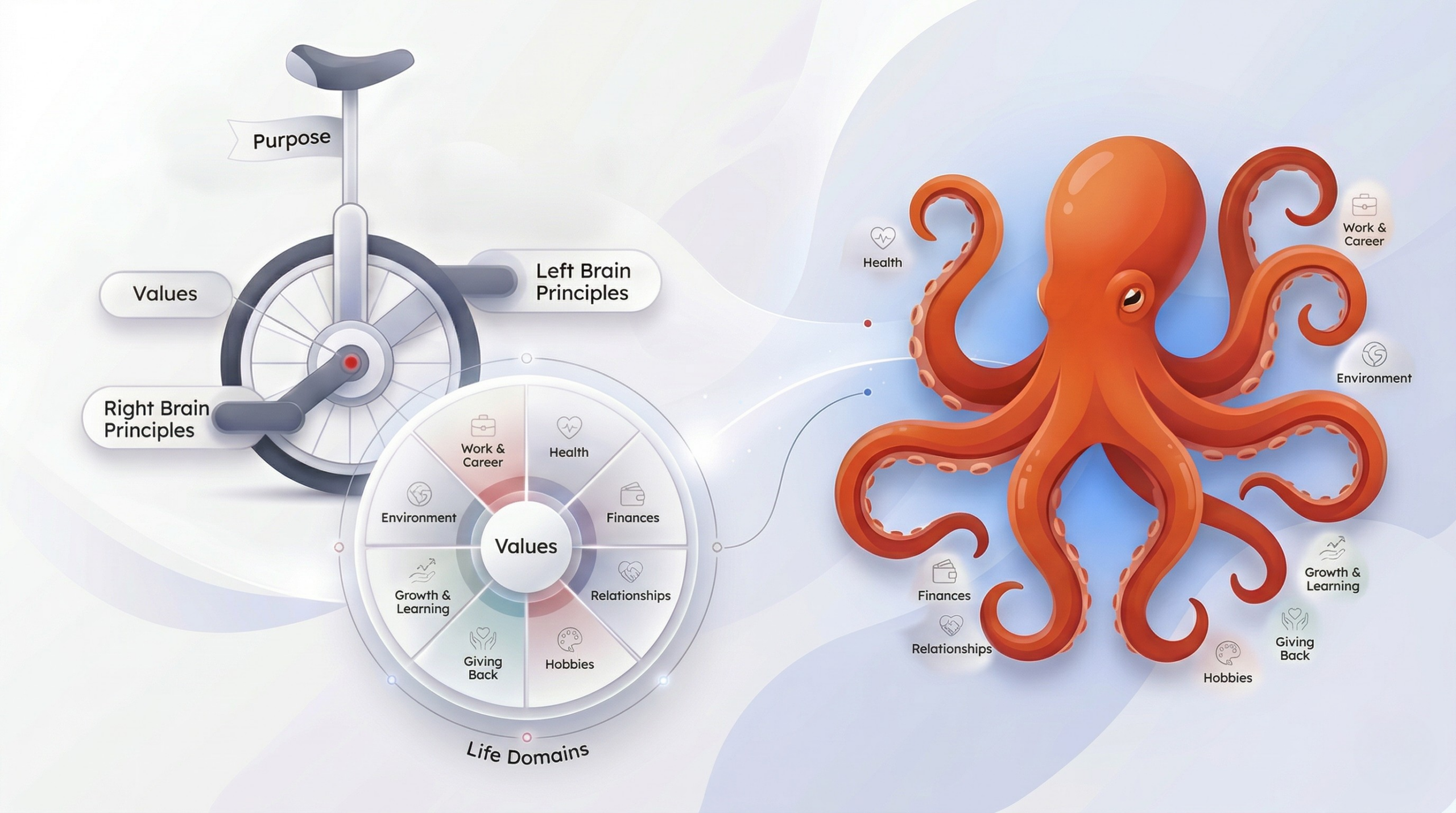
A clear identity that anchors every domain and lets each one operate with genuine autonomy.
➜ Work & Career
➜ Health
➜ Finances
➜ Relationships
➜ Environment
➜ Growth & Learning
➜ Giving Back
➜ Hobbies
Eight tentacles. Each one intelligent. All connected to one central body.
Same person. Different contexts. No fragmentation.
Transformation Fails When You Fix the Parts Without Changing the Operating Model
Werner and Le-Brun argue that transformation fails when companies fix the parts without changing the underlying operating model.
The same is true for people.
Most self-improvement fixes the parts (the habit, the routine, the career move) without touching the operating model underneath.
The Octopus Organization is the right model for companies.
ONELife is the same insight, for you.
Le-Brun and Werner nailed it for the boardroom. We built it for the person in the boardroom.
Is the Octopus Individual the future of how people need to live?
Ready to move from Tin Man to Octopus Individual? Take the ONELife Assessment to discover your Life Strategy Intelligence score across all eight domains and build the coherent operating model your life needs.
Because life is the work that matters most.